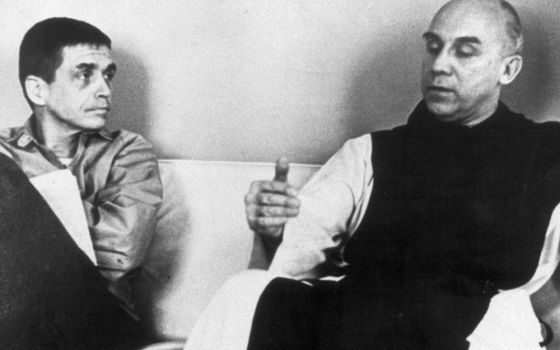
Berrigan's message to peacemakers: Persevere

Catholic icon speaks in rare public appearance

Dec. 08, 2010
Jesuit Fr. Dan Berrigan speaks at Mount Manresa Jesuit Retreat House on Staten Island, N.Y., Nov. 29. (Photos by Kenan Malkic)

STATEN ISLAND, N.Y. -- A breathless hush filled the overflowing room at Mount Manresa Jesuit Retreat House here as Jesuit Fr. Dan Berrigan slowly approached the podium. Organizers and audience seemed painfully conscious there wouldn’t be many more times this 89-year-old Catholic peace icon -- whose life has been punctuated with countless arrests and prison time, and guided by an unyielding commitment to Christian nonviolent resistance -- would appear in a public forum.

Now frail and bent, he carried with him to the front of the room not only more than a solid half century of peace work but also many associations with other peacemakers, including his late brother, Philip, and, on the 30th anniversary of her death, the cofounder of the Catholic Worker movement, Dorothy Day.

The Nov. 29 talk was billed as Berrigan’s reflection on Day. But as with any other Berrigan talk, it would cut to the essence and contain a message for his audience. And what would this peace message on this evening be?

Persevere.

“You have no right to tie yourself in knots because you want to know the outcome of what you are doing. Don’t, no, no. Let it go. Let it go into history. Let it go into Christ. Let it go into generations. Let it go into the children. Play it and pray it well.”

This was pure Berrigan, speaking in a soft and wispy voice that those who had gathered often needed to lean forward to hear. Wearing an old sweater and with blue long johns visible under the tattered cuffs of his khaki pants, this unassuming man reached into ancient scripture. He cited the second chapter of Isaiah -- “They shall beat their swords into plowshares” -- as he reflected on Day’s long-ranging impact on him as well as on the wider world.

Berrigan noted Day’s cautionary wisdom that “we may never see the good outcome of the good we do,” adding, as Day taught, that we must “do it anyway.”

Each of us must think, Berrigan told the audience, that “I am going turn swords into plowshares and spears into pruning hooks. I may never see the transformation myself. It makes no difference. I shall do it. I shall do it.”

For the implications of Berrigan's talk on U.S. military policy see NCR's editorial:
Quiet cancer of militarism on the US soul

Jesuit Fr. Dan Berrigan speaks with attendees after his talk at Mount Manresa Jesuit Retreat House Nov. 29.Jesuit Fr. Dan Berrigan speaks with attendees after his talk at Mount Manresa Jesuit Retreat House Nov. 29.Organizers had worked for months to bring the Manhattan-based priest to neighboring Staten Island, and to the retreat house for what Fred Herron, interim executive director, called “a little moment in history.”

NCR: February 17-March 1, 2012

Subscribe to NCR to get all the news and special features that aren't always available online. In this issue:

- Conscience Roundup
Hear what theologians, commentators, and our editors have to say about the contraception mandate

- Special Section: Religious Life
Work of missioners, past and future; African meetings; and more

- Tribute to a Peacemaker
New York's Pax Christi fetes Daniel Berrigan

Subscribe now!

The talk also provided an occasion for other Catholics to reflect on and assess Berrigan’s impact on the wider Catholic community.

“I’m glad to say that in the long run it’s really coming into focus now,” Jesuit Fr. Ray Schroth said in a telephone interview. “What has Dan Berrigan been to us? Two words come to mind. First: prophet. And then: teacher. ... Dan really takes the fact of God being in the world seriously and feels he’s got to get out there. And over the years he’s compelled us to come with him.”

It’s not easy to book Berrigan. He rarely speaks at public events. Herron said retreat center organizers had been trying to get him to speak for years with no success.

But this time was different, falling during the 100th anniversary of the center, which, according to Herron, was the first retreat house founded with the principal intention of serving the laity.

Maternal pride

The talk also allowed late cementing of a special connection between Berrigan and Day. Robert Ellsberg, publisher of Orbis Books and editor of The Duty of Delight and All the Way to Heaven, collections of Day’s diaries and letters, said that Day thought of Dan and Phil Berrigan as “her children.”

“She had relationships with many priests over her life, but the way that the Berrigans courageously took on the peace witness and were willing to go to prison was very important to her,” said Ellsberg in a telephone interview. “She felt a lot of maternal pride in their witness and the fact that they drew so much inspiration from the Catholic Worker.”

Speaking to NCR in a brief interview following his talk, Berrigan described his close, sometimes complicated relationship with Day. It began in spurts as the priest brought his students from St. Peter’s College in Jersey City, N.J., to the Catholic Worker in New York in the 1940s. It faltered, however, after Berrigan’s arrest in Catonsville, Md., for burning draft records.

In May 1968, Berrigan was among nine men and women who entered a Selective Service office, removed several hundred draft records, and burned them with homemade napalm in protest against the war in Vietnam.

Berrigan said he and Day didn’t talk much directly about the action, but she said clearly that it wasn’t “the way of the Catholic Worker.”

Looking back, Berrigan seemed almost wistful about that separation between him and his longtime mentor.

“The more I reflect on it, the more I wish we had talked [more about the action]. Because I don’t think there was that much difference [between us]. I think basic to her thinking was what I might call the cultural atmosphere of the ’60s at the Worker, which was very difficult for her. There was a lot of craziness going on, a lot of sexual stuff.

“She was very hurt and bewildered by all this, and I think she carried that over into a sense of bewilderment of ‘Well, what are these people doing now? This is very dangerous. This will result in violence.’

“Which it never did. It never did. We had beautifully trained people who were nonviolent in principle. But I wish we had talked. I think we were closer than she allowed, and that she was influenced by other events.”

The daily grind

It’s easy to imagine why those “other events” of the ’60s, coupled with the daily grind of life, might have come between Day and Berrigan after Catonsville. As those who have lived and worked in a Catholic Worker house know well, life within is often a mess of constant activity: filling coffeepots, sweeping floors, baking bread, finding a place for an unexpected guest to sleep -- sometimes with little room for rest, let alone relationship.

According to Ellsberg, it was precisely that mix of the routine that was the primary context for Day’s entire understanding of her life.

“People tend to think of Dorothy Day or the Berrigans as picket lines and jails and protesting and sitting in,” said Ellsberg. “Yes, their lives were marked by those kind of dramatic forms of witness. But just as heroic was the majority of their lives that was spent in very mundane ways, and as you see in Day’s diaries, the whole experience of the everyday was an arena for the practice of holiness.”

And what exactly does this mess achieve? What’s the impact?

In his talk, Berrigan said the answer is not found in the hope of any immediate outcome, but simply in doing good.

“I think Dorothy ... said in effect I may never know the outcome of what I’m going to do, but I’m going to do it anyway,” he said.

“We may never see the good outcome of the good we do. Do it anyway. Concentrate on the goodness of the work you’re doing. The outcome will take care of itself. The outcome is no concern of yours.”

Working out salvation

Berrigan said he now focuses his primary efforts on building community. It is a theme that has resonated through his -- and Day’s -- life.

For some, Berrigan might seem to some an odd proponent of community life. His relationship with other Jesuits has at times been tenuous. It’s a relationship that placed him in an exile of sorts to Latin America in 1965 after his provincial became upset with his connections and action within the peace movement and the Catholic Worker community.

Recalling an example of the tension between Berrigan and a friend, Schroth said that when Berrigan met Jesuit Fr. Robert Drinan for the first time in 1972, he immediately questioned Drinan about his run for a U.S. Congressional seat.

Schroth, author of a recently published biography of Drinan, said that Berrigan told Drinan that while he appreciated his opposition to the Vietnam War, “by running for office you involve yourself in the power structure in a way that inevitably is going to compromise you.”

In the eyes of some, it may be Berrigan’s struggle within community that has most closely aligned him with Day.

Community life was “a context in which [Day] had to work out her salvation,” said Ellsberg. “It was a source of incredible frustration, disappointment and anguish.”

Yet, “in community there was a lesson for everybody about what it means to be human and the context in which we are called to achieve our salvation -- because our salvation ultimately depends on love. And you can’t love all by yourself. Love is something that’s worked out in relationship to other people.”

More than six decades after Berrigan began introducing others to the Catholic Worker movement, having become personally enamored by Day’s life and dedication to hospitality and nonviolence, the priest quietly pondered a question put to him: “Where do we go from here?”

“Everything,” he responded, “comes out of a community sense that we can do something together, that we can face our fears and our future and our families because we are out of community, and our community is at least relatively independent of success.”

Pausing, then closing his thought, he added, grinning: “It’d better be.”

[Joshua McElwee is an NCR staff writer. His e-mail address is jmcelwee@ncronline.org.]

DOROTHY DAY

Born: Nov. 8, 1897
Died: Nov. 29, 1980

American journalist, social activist, Catholic convert, Christian anarchist. Worked closely with French immigrant Peter Maurin to found the first Catholic Worker, an intentional Christian community in New York City combining aid for the economically impoverished with nonviolent peace action. Starting with the publication of the Catholic Worker newspaper in 1933, her model inspired creation of similar communities worldwide. It continues today, with close to 200 Catholic Worker communities in the U.S. and abroad. Her autobiography, The Long Loneliness, was published in 1952. Day’s account of the Catholic Worker, Loaves and Fishes, was published in 1963. A collection of her letters, All the Way to Heaven, was released in October.

DANIEL BERRIGAN

Born: May 9, 1921

Jesuit priest, poet, peace activist. A college professor and Lamont Poetry Prize-winning poet before the Vietnam War, he became involved in antiwar activism at brother Philip’s insistence. Member of the “Catonsville Nine,” a group of Catholic protesters who broke into the Catonsville, Md., draft board on May 17, 1968, and destroyed its draft files using homemade napalm. Before spending three years in prison for the action, he successfully evaded arrest by the FBI for four months. He and Philip were for a time on the FBI Ten Most Wanted Fugitives list. Along with six others on Sept. 9, 1980, the two brothers trespassed on to the General Electric Nuclear Missile facility in King of Prussia, Pa., where they damaged nuclear warhead nose cones and poured blood onto documents and files. That action spawned the Plowshares movement, a collection of anti-nuclear-weapons protests inspired by Isaiah’s call to “beat swords into plowshares.”

Thank you, Josh for this

Thank you, Josh for this wonderful profile of Fr. Dan. I remember meeting him a few years ago in Clinton Corners, NY, where he spoke so eloquently about peacemaking. He took questions afterwards, and someone asked him about the hierarchy. He though a moment and answered in this way: I don't know. I'm a proud member of the lower-archy.
You're the best, Fr. Dan.

What a great joy to see these

What a great joy to see these two remembered and celebrated. I was greatly affected in the 1960s to see the quotation from Dan Berrigan "I would rather be blamed for what I have done, then for having done nothing". I was priveleged to see him in a reading of the Cantonsville 9 play in Des Moines at Bishop Dingman's home. I fear we have fallen into complacency and seeing the words of such a great icon makes that all the more obvious. Thgank you for reporting on what may be one of his last appearances.

I've been privileged to hear

I've been privileged to hear Dan on several occasions, including retreats he gave at Pyramid Lake in upstate New York. However my sharpest and fondest recollection is of a talk he gave one night in East Islip, Long Island, at the height of the Vietnam War. As he was taking questions after the talk, an obviously disapproving and antagonistic individual asked him: "What will you do with yourself; what cause will you turn to after this war is over?" I don't recall exactly what Dan replied but I continue to be struck by the manner in which he said it: with no trace of impatience or resentment, as if the questioner had just paid him a great compliment. Way back then he was already a man of peace, with not an ounce of violence in him. God bless Dan Berrigan.

I'm often struck by the

I'm often struck by the sanity of what Father Berrigan says, in his poetic way, and the contrasting strike of what the "world" or "culture" says in contrast, of, for example, where our attention should be...what is of importance.

He's a great poet too and underappreciated there - though some of the "actions" of living theater have a poetic quality. And his books on the prophets are outstanding, and his diaries....

He changed my life - it's beyond my understanding why people don't see what he sees...what he "traces with his finger..."

Low-archy power!

Love you Father Dan

no weirdo are you, for I love

no weirdo are you, for I love them all too, as you list, and don´t step back or I will list each and every one!

As a Catholic layman during

As a Catholic layman during the 1960s, 1970s and into the 1980s, I made my annual retreat at the large Jesuit Retreat House at Faulkner, MD. Almost inevitably the first question that came up at every evening Q/A session was the Berrigan brothers. The Jesuits would castigate them as being
"loose cannons" whose conduct was totally out of line with the Church and the Law. Their minority thinking and action was not to be emulated by any of the laity of that period. This, of course, left many of us laymen confused. The Berrigans were to be ignore and the matter shoved under the carpet of church history. The refusal of the Church hierarchy and leadership to seize the occasion at the time to debate the issue of peacemaking/war at the highest levels was a terrible mistake. It is coming back to haunt us -- much like the cover up of the clergy sex abuse of the same period that received the "carpet" treatment. Bob

Sorry to disagree, but I

Sorry to disagree, but I think Berrigan is an egocentric and self-important traitor. How does his mindset differ from that of some Muslim extremist who kills for Allah's sake, completely certain of the validity of his actions? Does everyone forget that Berrigan's actions had vast implications for the safety and security of others? Who the hell does Berrigan think he is, a morally superior being somehow compelled by his own importance to damage public property and throw away the lives of others? I am a practicing Catholic who finds his actions beneath contempt and morally misguided.

You should get on your knees

You should get on your knees and thank Berrigan. If it weren't for people like him, we'd still be fighting in Viet Nam and probably would never have been able to invade Iraq. Then where would we be?

"You should get on your knees

"You should get on your knees and thank Berrigan."

I do, and for more reasons than these

Joe R. it seems there's a

Joe R. it seems there's a streak of violence in you.

An "egocentric and

An "egocentric and self-important traitor," "beneath contempt and morally misguided," "compelled by his own importance to damage public property and throw away the lives of others"? There are no facts in your condemnation, only fear and anger. Dan never hurt anyone, and the only property he damaged consisted of draft records. (He didn't actually damage the nukes.)

His actions were powerful statements against the state mindset of fear and arrogance that jumped into a foolish, evil war needlessly killing hundreds of thousands of people (including 58,00 Americans), and using nuclear weapons as an exercise of power that threatens to destroy billions of lives.

The difference between Dan and a terrorist is that Dan acts from a center of peace and love, and has never even threatened physical harm to anyone, much less killed others. The "vast implications for the safety and security of others," are that if everyone emulated Dan, we would have a very peaceful, just world.

Joe R: You raise some

Joe R:
You raise some interesting points. If your questions are more than rhetorical, I'll make an effort to explain a little of how I see it. Father Berrigan had by the time of Catonsville been in Vietnam as an observer and to some extent victim of the bombings by the U.S. He had carried the bodies of napalmed children in boxes. In other words, he was not an intellectual sitting on his laurels or butt passing judgement on the side-lines. He had seen the horror up close and personal. He was outraged that we were burning children alive in the name of National Security. He had seen that the U.S. middle-class were more interested in watching "Bewitched" than the reality of the war. He thought the action might wake them up a little and it did.

I can see him as an extremist but not for Allah or God, but for peace. But he does not kill for peace, as our leaders here so often do. And yeah, he does come off as arrogant sometimes.

The point about when a person can break the law in the name of doing what is right, and when the law is sacred, I don't know - it takes us back to the Nuremberg trials, which plowshares activists often will try to cite when defending what they do.

Keep practicing.

Keep practicing.

Yes, someday the "Lion will

Yes, someday the "Lion will lie down with the lamb" and we shall realize the true peace that flows only through understanding.
What a saintly and powerful man of God and what an example of perseverance for each of us!

I don't agree that Dorothy

I don't agree that Dorothy Day's disagreement with Dan Berrigan is easily explained away as her bewilderment or preoccupation with things at the Catholic Worker. She may have had good reasons to disagree with the burning of draft cards with naplam. That is a violent act. She did not see it as the way to do things. He may be sorry that he did that. Rather than say he is sorry, he says he is sorry he did not talk her into seeing it his way.

His reported comments to Fr. Robert Drinan show a man who is judgmental. Not every one has to take the same path, and Drinan believed in what he was doing when he ran for office. Let Berrigan stand for what he believes in, but let others disagree. He has a right to be who he is. Others have a right to be who they are.

what constitute a violent

what constitute a violent act? destruction of a human being or destruction of things that destroy the human being? Wasn't the act of Berrigan of latter category?

what is being judgmental? Does making a strong opinion on an act of a person and not on his person make one judgmental?

www.openhearts.org Just for

www.openhearts.org

Just for fun.

This is the website of one of the FBI Agents who pursued Dan Berrigan. Check it out to restore your faith in "the long haul". Forty years of work dedicated to the poorest people he could find on the planet!
We Catholics cover all points on every spectrum. ("Here comes everybody!") In focusing on our differences,we often forget the family resembalance!

Yes, thank you, Josh, for

Yes, thank you, Josh, for sharing this event with us - this man of God, of constant inspiration!! Love/peace, Elizabeth

How time flies. I hope Fr.

How time flies.

I hope Fr. Dan lives to see the end of the Afgahnistan war. President Obama's commander said we will be there about 60 more years, when Fr. Dan will be 147.

And his other wars, Yemen and Pakistan could take longer. But we can rejoice that its the good war, as the President has said, and I'm certain he has a reason for it.

ad Multos Annos

This is a wonderful glimpse

This is a wonderful glimpse of Dan today. As a religious, I am gladdened by his focus upon the significance of community, in the later years of his life, as am I at the same age.

No wonder the wiser Dorothy

No wonder the wiser Dorothy Day did'nt join the radical Berigans with their napalm silly behaviour.

Asking such a loaded question about the 'hierarchy' obviously begged the funny reply of Fr Dan's, but really it was all pretty immature stuff in those days.
Isn't it more radical to 'turn the other cheek' ?

it is wiser and far holier

it is wiser and far holier not to cooperate in any manner with this great machine of war

As Dan Berrigan said so

As Dan Berrigan said so eloquently long ago, referring to the burning of draft files... (and I paraphrase) Americans know it is far better to burn people than to burn paper. He called the draft records "hunting licenses" for humans.
He changed my life too and my understanding of Christian nonviolence. It is not passivity in the face of evil. Not everyone will discern the same call to action but people like Dan and Phil and the other activists against war make us all examine our consciences and often, like the young man in the gospel, go away sad because we just can't seem to give all.

So Dan: Why is it that you

So Dan: Why is it that you have steadfastly refused to align yourself with the survivors of sexual abuse and exploitation by your brothers in the Society of Jesus?

If you want peace--- work for justice. Or at least... don't ignore it.

"Let's say no when it needs saying."

Isn't that your quote?

How about saying "no" to your brethren who exploited children and vulnerable
adults?

Father Daniel Berrigan is a

Father Daniel Berrigan is a true Saint in our midst!!!

Chuck from Minneapolis

At the conclusion of

At the conclusion of documentary-director Lee Lockwood's chronicle of Berrigan underground--"The Holy Outlaw"--Father Dan was asked by a reporter, "What are your future plans?" Berrigan, being led away in handcuffs, turned to him, and managing somehow to give the peace sign, smiled: "Resistance!"This would be akin to, certa bonum certamen--fight the good fight.

Bonhoeffer:

“First they came for the Communists, but I was not a Communist so I did not speak out. Then they came for the Socialists and the Trade Unionists, but I was neither, so I did not speak out. Then they came for the Jews, but I was not a Jew so I did not speak out. And when they came for me, there was no one left to speak out for me.”

That was actually Niemoeller,

That was actually Niemoeller, WWI submarine commander and post WWI Lutheran pastor. He opposed the Nazi takeover in Germany.

quite

But when Pol Pot came for the

But when Pol Pot came for the people the Berrigans had us abandon, the Berrigans were there. Yessire, there on TV, to speak for the victims of the communists. And they said nothing.

how do you know chris when

how do you know chris when you were not?

And how did the Berrigan brothers have "us" abandon Cambodia?
In what way?

Pol Pot was our puppet

Here is what Arun Gandhi said

Here is what Arun Gandhi said about the Plowshares Action:

Arun Gandhi said: "You can quote me as saying Mahatma Gandhi would disagree with the Plowshares actions because they employ tactics of secrecy and destruction of property. I also think locking up the most courageous and devoted peace leaders for long prison terms is a way of weakening the peace movement. Those leaders could do much more for peace outside of jail than in it." ( The Jesus Journal - Summer 1995 - No. 77 - page 44 )

"Common people who are not directly involved in social debates and political conflicts have their lives to live, they become angry at those who are disturbing their lives or damaging property that has to be repaired using public funds. Thus the average person, whose support is often necessary for lasting success, is alienated. Rather than leading to a resolution, they escalate the conflict and create more deeply entrenched opponents." (Legacy of Love by Arun Gandhi – page 132)

If that sweater doesn't say

If that sweater doesn't say old Jesuit, I don't know what does!

"A breathless hush"....oh my,

"A breathless hush"....oh my, a bit dramatic?

guess you had to be there.

guess you had to be there.

Same thing happened when I saw him in the seventies, and that was deep in the inner city . . .

not a place noted for a hush, breathless or not, but wow did it get quiet, and respectful, and loving, something we no longer do anywhere in anglophone America . . .

Post new comment

NCR Comment code:

  1. Be respectful. Do not attack the writer. Take on the idea, not the messenger.
  2. Use appropriate language. Avoid vulgarities and slurs.
  3. Keep to the point. Deliberate digressions don't aid the discussion.

For more detailed guidelines, visit our User Guidelines page.

The content of this field is kept private and will not be shown publicly.
(if you have one; if not, leave this blank)
  • Web page addresses and e-mail addresses turn into links automatically.
  • Allowed HTML tags: <a> <em> <strong> <cite> <code> <ul> <ol> <li> <dl> <dt> <dd> <font> <swf> <swf list>
  • Lines and paragraphs break automatically.
  • You may use <swf file="song.mp3"> to display Flash files inline

More information about formatting options

CAPTCHA
This is to prove you are a human visitor and to prevent automated spam submissions.
Image CAPTCHA
Enter the characters shown in the image.